

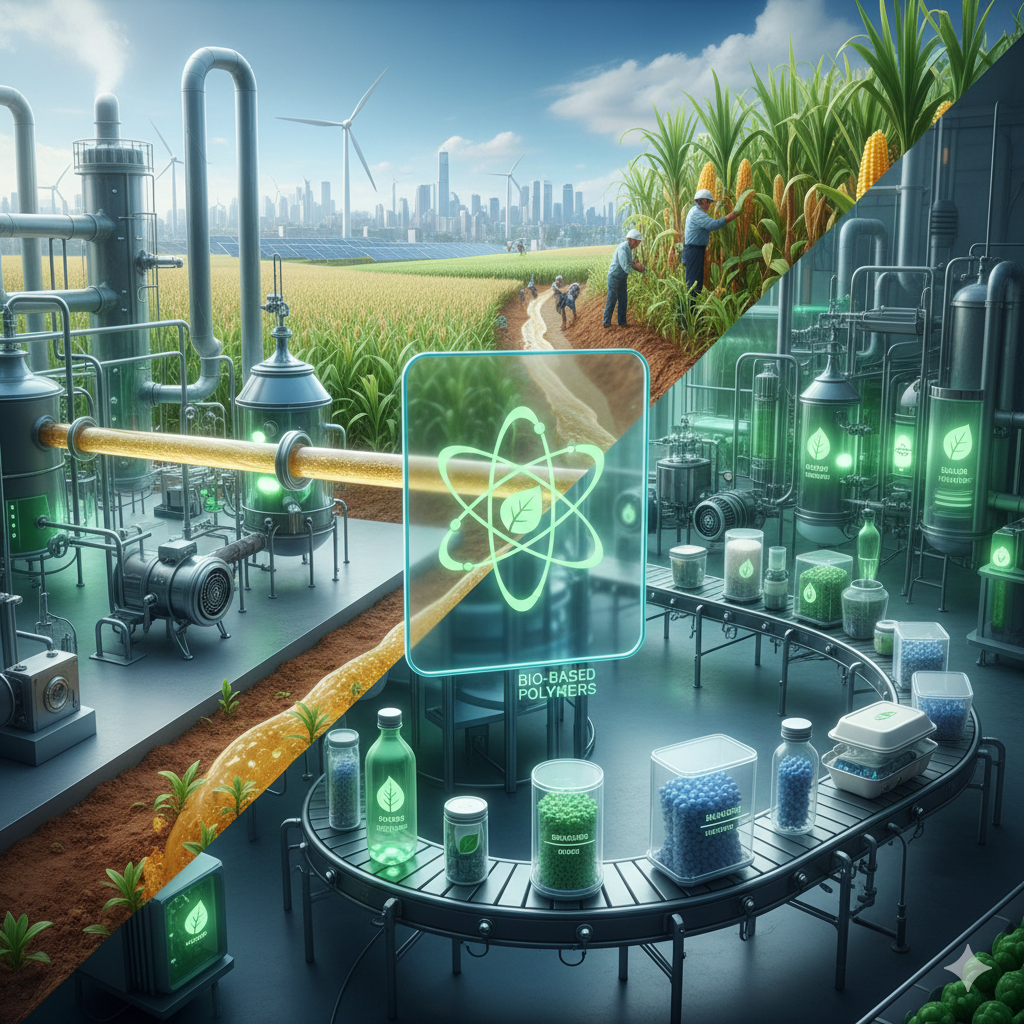
The global shift towards a circular economy is gaining irreversible momentum. At its heart lies a critical mandate: to decouple economic growth from finite resource depletion and environmental degradation. Two powerful pillars are emerging as the cornerstone of this transformation in industrial production: green chemistry and the adoption of bio-based feedstocks, together orchestrating a systemic replacement of fossil fuels.
The Imperative of the Circular Economy
Traditional linear economic models (“take-make-dispose”) are inherently unsustainable. They deplete natural resources, generate vast amounts of waste, and contribute significantly to climate change. The circular economy, by contrast, aims to keep resources in use for as long as possible, extract the maximum value from them whilst in use, and then recover and regenerate products and materials at the end of their service life.
- Resource Scarcity: Finite fossil fuels are dwindling, and their extraction carries immense environmental costs.
- Climate Change: Burning fossil fuels is the primary driver of greenhouse gas emissions.
- Waste Crisis: Landfills are overflowing, and plastic pollution chokes our oceans.
- Economic Opportunity: The circular economy fosters innovation, creates new jobs, and builds resilient supply chains.
Green Chemistry: Designing Sustainability from the Molecular Level
Green chemistry is not just about pollution control; it’s about pollution prevention by design. It’s a philosophy that applies throughout the lifecycle of a chemical product, including its design, manufacture, use, and ultimate disposal. Its principles guide chemists and engineers to create products and processes that minimize the use and generation of hazardous substances.
- Prevention: It is better to prevent waste than to treat or clean up waste after it has been created.
- Atom Economy: Maximize the incorporation of all materials used in the process into the final product.
- Less Hazardous Chemical Syntheses: Design synthetic methods to use and generate substances that possess little or no toxicity to human health and the environment.
- Safer Solvents and Auxiliaries: Avoid the use of auxiliary substances (e.g., solvents, separation agents) wherever possible and, when used, make them innocuous.
- Design for Degradation: Design chemical products so that at the end of their function they break down into innocuous degradation products and do not persist in the environment.
- Real-time Pollution Prevention: Analytical methodologies need to be further developed to allow for real-time, in-process monitoring and control prior to the formation of hazardous substances.
Green chemistry principles are foundational in developing alternatives to petrochemicals, making processes more efficient, and designing products that are safer and more easily recyclable or biodegradable.
Bio-Based Feedstocks: Nature’s Blueprint for Industry
Bio-based feedstocks refer to raw materials derived from renewable biological resources, such as biomass (plants, algae, agricultural waste, and forestry residues), rather than fossil fuels. These feedstocks are rapidly replacing petroleum in the production of a vast array of industrial chemicals, polymers, fuels, and materials.
- Renewability: Unlike fossil fuels, bio-based feedstocks can be continuously replenished through sustainable agriculture and forestry.
- Carbon Neutrality (Potential): When sustainably sourced, the CO2 released during the lifecycle of bio-based products can be offset by the CO2 absorbed by the plants during their growth, leading to a near net-zero carbon footprint.
- Biodegradability: Many bio-based materials are inherently biodegradable, reducing persistent pollution.
- Reduced Toxicity: Often, bio-based alternatives are less toxic than their petrochemical counterparts.
- Examples in Action:
- Bio-plastics: Polylactic acid (PLA) from cornstarch or sugarcane replaces conventional plastics in packaging, textiles, and even automotive parts.
- Biofuels: Ethanol from corn or cellulosic biomass and biodiesel from vegetable oils offer alternatives to gasoline and diesel.
- Biochemicals: Succinic acid, butanediol, and other platform chemicals can be produced via fermentation of sugars, serving as building blocks for a multitude of industrial products.
- Bio-lubricants & Solvents: Derived from vegetable oils, offering eco-friendly options.
The Synergy: Green Chemistry & Bio-Based Feedstocks
The true power lies in the synergistic combination of green chemistry principles applied to bio-based feedstocks.
- Efficient Conversion: Green chemistry enables the development of catalytic processes that efficiently convert complex biomass into desired chemicals with minimal waste and energy consumption.
- Sustainable Product Design: It guides the design of bio-based products to be inherently safer, more durable, and ultimately biodegradable or recyclable, closing the loop of the circular economy.
- Reduced Environmental Footprint: This combination drastically reduces reliance on finite resources, lowers greenhouse gas emissions, and minimizes the generation of toxic byproducts throughout the entire industrial value chain.
The Road Ahead
The transition away from fossil fuels in industrial production is a monumental task, but the advancements in green chemistry and the increasing availability and diversification of bio-based feedstocks are paving a clear path. This shift is not merely an environmental necessity but a profound economic opportunity, driving innovation and fostering a resilient, sustainable future where industry thrives in harmony with the planet.